
FREE Printable Kitchen Conversion Chart

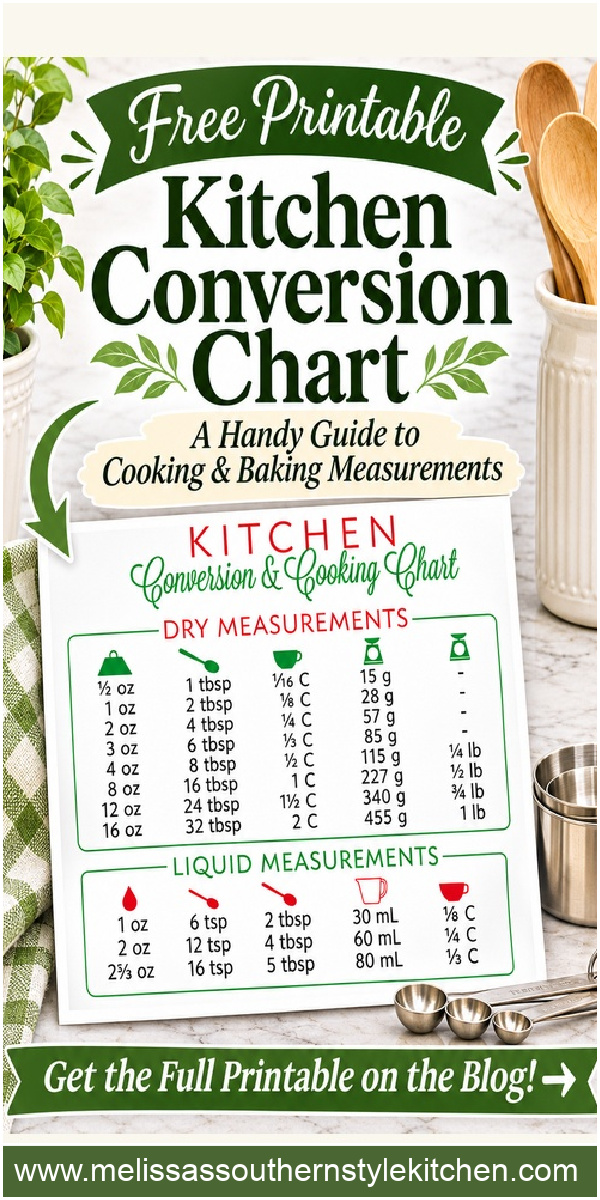


Take the guesswork out of recipe conversions with this FREE Printable Kitchen Conversion Chart! Keep it handy in your kitchen for quick and easy conversions between US customary and metric measurements whenever you’re cooking or baking. It’s a must-have kitchen reference for home cooks and bakers alike!
Easy FREE Printable Kitchen Conversion Chart
One of the things I love most about sharing recipes is connecting with people around the world through cooking and baking. I have readers visiting from all corners of the globe, and I’m often asked to include metric conversions alongside the US customary measurements in each recipe.
While adding every conversion to every recipe isn’t always practical, I wanted to offer a helpful alternative. This FREE Printable Kitchen Conversion Chart makes it easy to convert US to metric cooking and baking measurements, including common kitchen measurements and recipe equivalents. Simply print a copy, keep it handy in your kitchen, and you’ll have a quick reference whenever you’re cooking or baking from a recipe!
How to Use FREE Printable Kitchen Conversion Chart
Having a kitchen measurement conversion chart handy makes cooking and baking much easier, especially when you’re following recipes that use different measurement systems. This FREE printable kitchen conversion chart is designed to help you quickly reference US customary measurements and metric equivalents without having to stop and look up conversions.
I also have a handy chart for Common Baking Substitutions that you can reference when you find yourself short on a particular ingredient right in the middle of a cooking project. It’s always helpful to have a few kitchen cheat sheets close by!
Having the right kitchen measuring tools makes a difference in the accuracy and consistency of your recipes. Whether you’re preparing a weeknight supper or baking a homemade cake from scratch, here are a few essentials worth keeping in your kitchen.
A Kitchen Scale: Some bakers prefer to weigh ingredients using a kitchen scale for more precise measurements. A scale can be particularly helpful when following recipes that list ingredients in grams or ounces by weight. That said, I’ve been an avid home baker for many years and have always measured ingredients for cakes, muffins, cookies, pies and homemade breads using measuring cups and spoons with great success. A kitchen scale is a useful tool, but it’s certainly not imperative to be a successful home baker.
Dry Measuring Cups: These are used to measure dry ingredients such as flour, sugar, oats and other baking staples. When measuring flour, never scoop directly into the flour container with your measuring cup. Instead, spoon the flour into the measuring cup and level it off with a straight edge. Scooping directly can compact the flour, resulting in too much being added and potentially dry, dense baked goods.
Liquid Measuring Cups: Glass or plastic liquid measuring cups typically come in 1, 2, 3 and 4 cup sizes. They’re designed with measurement markings along the side, along with a handle and spout for easy pouring. Use these for measuring liquids such as milk, water, oil and broth. Measuring cups make it easy to reference cup and fluid ounce equivalents when following a recipe. Larger measuring cups are also available, although the standard sizes are generally sufficient for everyday home cooking and baking.
Measuring Spoons: A basic set of measuring spoons typically includes 1/8 teaspoon, 1/4 teaspoon, 1/2 teaspoon, 1 teaspoon and 1 tablespoon. Some sets include additional sizes, such as a 2 tablespoon measure. Having a variety of measuring spoons on hand makes it easier to accurately measure smaller amounts of ingredients like baking powder, baking soda, salt, vanilla and spices.
Common Kitchen Measurement Abbreviations
I typically spell out measurements in the narrative of recipes on my website. However, you may occasionally see abbreviations in the recipe card itself. I make an effort to remain consistent, but measurement abbreviations can vary from one recipe website to another. Here’s a quick reference for some of the common cooking and baking measurement abbreviations you may encounter.
- Tbsp = tablespoon
- tsp = teaspoon
- oz = ounce
- C = cup (I most often spell this one out.)
- P = pint (2 cups)
- QT = quart (4 cups)
- lb or LB = pound
Keeping these common kitchen measurement abbreviations and equivalents handy can make following recipes a little easier, especially when converting measurements or preparing recipes from different sources.
What’s the Difference Between Fluid Ounces and Ounces?
One common point of confusion when converting cooking and baking measurements is the difference between fluid ounces and ounces by weight. Although they sound similar, they measure two different things.
Fluid ounces (fl oz) measure volume, or how much space a liquid takes up. You’ll commonly see fluid ounces used when measuring water, milk, broth, oil and other liquids. In US customary measurements, 8 fluid ounces equal 1 cup.
Ounces (oz) typically refer to weight when measuring ingredients. For example, a recipe may call for 8 ounces of chocolate chips, cheese or butter. These measurements are taken using a kitchen scale rather than a liquid measuring cup.
It’s important to remember that 8 fluid ounces does not always equal 8 ounces by weight. The weight of an ingredient depends on its density. This distinction is especially helpful when converting American recipes to metric measurements, since liquid volume is generally converted to milliliters (ml), while ingredient weight is converted to grams (g).
When in doubt, always pay attention to whether a recipe is calling for a volume measurement or a weight measurement. It’ll help you get more accurate results in the kitchen!
Quick Reference:
- Fluid ounces (fl oz): Measure liquid volume.
- Ounces (oz): Measure weight.
- Milliliters (ml): Metric measurement of liquid volume.
- Grams (g): Metric measurement of weight.
Print this Kitchen Conversion Chart and laminate it then keep it posted somewhere in your kitchen. You may also opt to mount it on the inside of a cabinet door so it’s available to reference lickity split.
Print the FREE Conversion Chart Here!

Special Note About Dry Measurements
Ounce-to-cup and ounce-to-tablespoon conversions are approximate and can vary depending on the ingredient. Since dry ingredients have different weights, using a kitchen scale will provide the most accurate measurements, especially when baking.
Southern Style Recipes to Make Using a Conversion Chart
I most often get asked about conversions for baking. If you’re ready to stretch your legs in the kitchen and get busy with your new metric conversion chart, I wanted to point you in the right direction.
- Southern Buttermilk Pie is a creamy custard pie with a filling that’s made using buttermilk.
- Delicious soft and fluffy Honey Yeast Rolls.
- My big and beautiful Italian Cream Cake is a sight to see.
- Chocolate Mayonnaise Cake is a single layer cake topped with a fudgy frosting and chocolate curls.
- Dutch Oven Artisan White Bread is delicious warm slathered with butter for dipping in soups and stews or turned into a sandwich.
- Made from scratch Butter Pecan Cookies won’t last long in your cookie jar.
- Fluffy Southern Buttermilk Biscuits are a fan favorite!
- Raspberry Doughnuts from Paul Hollywood.
Thanks for visiting come back soon!
Disclosure ~ If a purchase is made using one of the affiliate links on this website we may earn a small commission at no additional cost to you. Thank you!
Helpful Kitchen Items:
Loved it, looks great in my Kitchen.
Thank you for the FREE chart. Its beautiful . Just what I need for my new farm life.
I’m so happy you find it helpful, most welcome!
This chart is exactly what I was looking for the Mrs!
Thank you!
Perfect chart, just what a swedish wannabe chef would love in order to make some Amercan meals. There was however, two minor mistakes in the end… The table of Liquids define 32 oz as 0.950 mL but the can below propose to carry 946 Liters. That’s quite a can!!
Decimals aside: Which is the correct measure, 950 or 946?
The Pint can makes a similar decimal mistake…. 😀
Thank you very much for the chart!!! I expect to put it to good use.
Hi there! What a difference a decimal can make, right? Corrected, enjoy!
Thank you so much! I am baking sourdough and love recipes from USA bakers. But since I live in the Netherlands, I don’t understand anything about Fahrenheit 😉 I have to google the corresponding Celcius everytime. I printed this conversion chart because it is so complete. Thank you again.
I’m delighted you find this helpful!
Thank you so much for this, Melissa. We are living in Australia for 18 months on a mission for our church and I am constantly googling the conversion. So happy I found this. I’m going to print another one for my Australian friend I am sharing recipes with so she can convert the other way. You are a gem!
I’m so happy you find this helpful! Blessings on your mission work ♥
yes, thank you very handy to have around in this format. Appreciate all that you do for us. Cathy
I’m delighted you will find this helpful, thanks Cathy!
Melissa Thank you SO much for the conversion chart. So often in the middle of a recipe I must run and get my computer and google the conversion measurements This will be a time saver for sure..
I’m so happy you find it helpful!
Thank you so much for consolidating the conversions and substitutions. I will definitely keep them at hand instead of running to my computer for help. Love your recipes!! 🙂
I hope it’s helpful, Brenda!